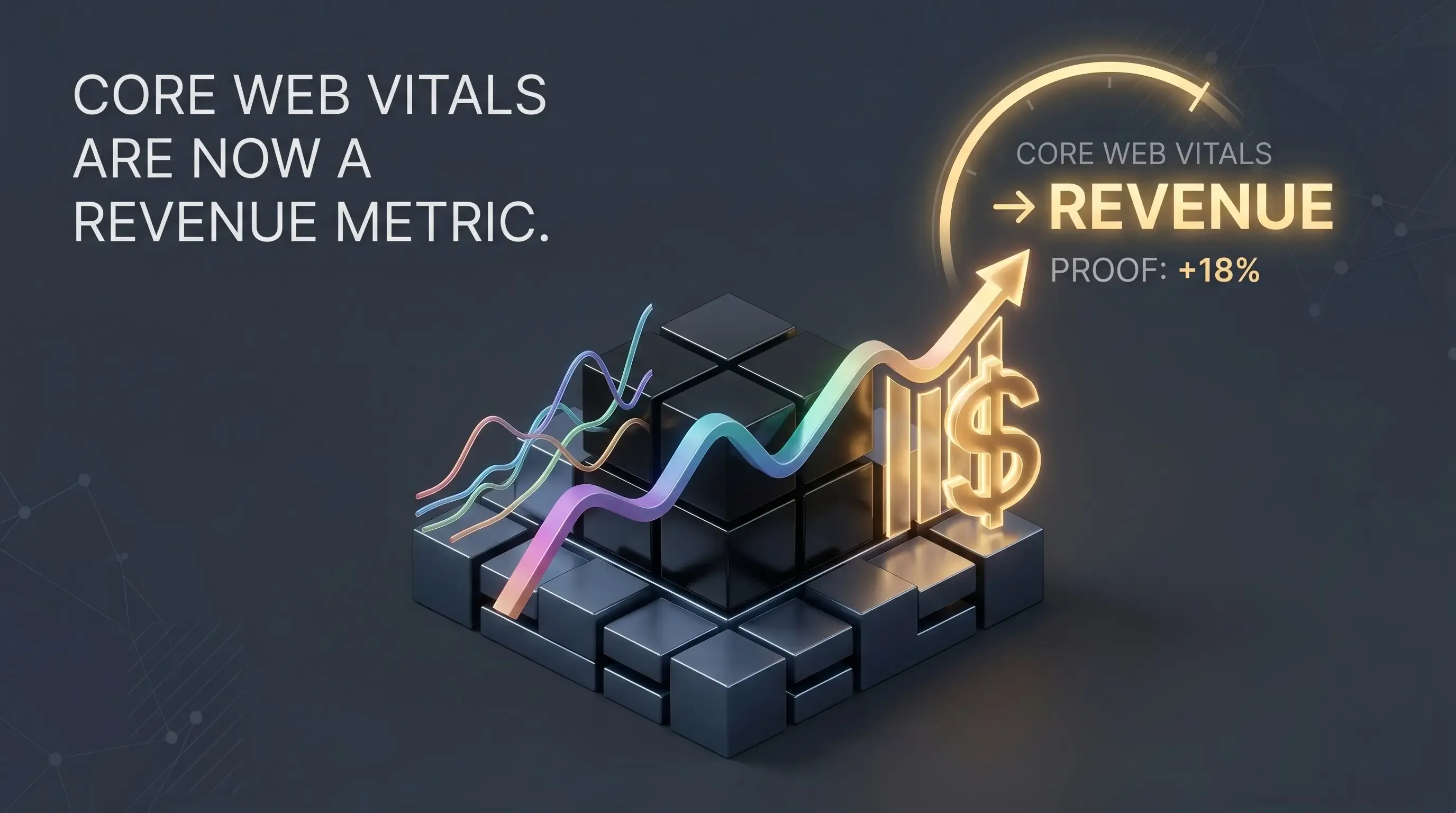
Core Web Vitals Are Now a Revenue Metric. Here Is the Proof.
For most of the past decade, website performance was a technical concern — something that developers worried about and business owners approved a line item for when the complaints got loud enough. That has changed. In 2025, the relationship between website speed and business revenue is documented, quantified, and commercially significant enough that ignoring it is a financially consequential decision.
This post translates the technical language of Core Web Vitals into the business language of conversion rates, revenue per visitor, customer acquisition cost, and competitive positioning. By the end, you will have the data you need to evaluate whether your website's performance is a competitive asset or a hidden liability.
What Core Web Vitals Actually Measure
Google's Core Web Vitals are three specific measurements of how a real visitor experiences your page. They are not Lighthouse scores or theoretical benchmarks — they are measured from actual user sessions, aggregated in the Chrome User Experience Report, and used directly in Google's ranking algorithm.
- Largest Contentful Paint (LCP): How long it takes for the largest visible element on the page to load. This is usually your hero image, headline, or above-the-fold video. Target: under 2.5 seconds. Poor: over 4 seconds.
- Interaction to Next Paint (INP): How quickly the page responds to user inputs — clicks, taps, keyboard interactions — across the entire session. Replaced First Input Delay (FID) in 2024 as a more comprehensive responsiveness measure. Target: under 200 milliseconds. Poor: over 500ms.
- Cumulative Layout Shift (CLS): How much the page layout visually shifts during loading — images appearing and pushing text down, fonts swapping and reflowing content, ads loading and displacing buttons. Target: under 0.1. Poor: over 0.25.
Google has confirmed that Core Web Vitals are a ranking signal. The practical effect: when two pages compete for the same keyword with comparable content quality, the page with better Core Web Vitals will rank higher. In competitive markets, CWV is the tiebreaker that determines whether your page appears on the first page of results or the second.
The Revenue Data: What the Research Actually Shows
Conversion Rates
The most direct commercial impact of performance is on conversion rate — the percentage of visitors who take the action you want (book a call, fill a form, make a purchase, request a demo).
- Improving Core Web Vitals from "Poor" to "Good" rating correlates with an average 25% increase in conversion rates (Google CWV case studies, 2024)
- A 1-second delay in page load time reduces conversions by 7–20% depending on the industry (Aberdeen Group)
- Vodafone achieved a 31% improvement in LCP and a corresponding 8% uplift in sales after targeted performance optimisation
- Renault saw a 14% increase in conversions after improving their INP score from Poor to Good rating
Bounce Rate and Engagement
Bounce rate — the percentage of visitors who arrive and leave without any interaction — is directly correlated with load time. Every second of additional load time increases the probability of an immediate exit:
- Load time 1 second → 2 seconds: bounce rate increases by 32%
- Load time 1 second → 3 seconds: bounce rate increases by 53%
- Load time 1 second → 5 seconds: bounce rate increases by 90%
- Load time 1 second → 10 seconds: bounce rate increases by 123%
For a business receiving 10,000 monthly visitors with a 3-second load time, moving to a 1-second load time would mean approximately 5,300 fewer immediate exits per month — visitors who stay long enough to become leads.
Revenue Per Visitor
Beyond conversion rate, performance affects how much revenue each engaged visitor generates. Faster pages correlate with longer sessions, more pages viewed, higher average order values, and stronger brand perception.
- Businesses optimising performance metrics see an average 30% improvement in revenue per visitor (WPO Stats research)
- Walmart found that every 1-second improvement in page load time resulted in a 2% increase in conversions
- COOK (an e-commerce brand) reduced page load time by 0.85 seconds, resulting in a 7% increase in conversions, 7% decrease in bounce rate, and 10% increase in pages per session
The SEO Compounding Effect
Performance improvements compound through SEO in a way that makes them self-reinforcing over time. The mechanism works as follows:
- Better CWV scores → higher rankings: Google's Page Experience signal uses Core Web Vitals as one input. Better scores → improved rankings for contested keywords → more organic traffic.
- More organic traffic → more conversions: At the same conversion rate, higher traffic volume means more leads and sales from the organic channel, which has the lowest customer acquisition cost of any marketing channel.
- Lower bounce rate → stronger ranking signal: Google's ranking algorithm considers engagement signals. If visitors consistently stay longer and engage more with your content, this reinforces your ranking for related queries.
- Better rankings → more brand visibility → lower CAC: As organic visibility increases, the cost per acquired customer from organic falls — compounding the ROI of the initial performance investment.
This compounding effect means that the business value of a performance improvement is not a one-time conversion rate lift — it is a sustained, growing competitive advantage that accumulates over time as better performance → better rankings → more traffic → more conversions.
What Poor Performance Is Costing You Right Now
The most useful way to think about poor website performance is not as a cost you have not yet incurred, but as revenue you are currently losing. Let us make this concrete.
If your site currently loads in 4 seconds and you receive 5,000 visitors per month with a 2% conversion rate, and a conversion is worth £500 in lifetime customer value:
- Monthly revenue from site: 5,000 × 2% × £500 = £50,000
- Improving to 2-second load time (25% CWV conversion lift): 5,000 × 2.5% × £500 = £62,500
- Monthly uplift: £12,500
- Annual uplift: £150,000
This is a conservative estimate that does not account for the SEO traffic improvement from better rankings, the bounce rate reduction, or the revenue-per-visitor increase from longer sessions. The actual return on performance investment for a typical business site is typically 3–10x the cost of the optimisation work within the first year.
Why WordPress Sites Structurally Cannot Achieve Good CWV
The most common question we receive after sharing these statistics is: "can I just install a performance plugin on my WordPress site?" The honest answer is: you can improve performance within the constraints of the architecture, but you cannot escape the architecture's ceiling.
WordPress sites have several structural performance constraints that plugins can mitigate but not eliminate:
- Every uncached page request executes PHP on the server: database queries, plugin hooks, theme rendering — before the first byte is sent to the browser
- The WordPress plugin ecosystem averages 15–30 active plugins on a typical business site, each of which adds HTTP requests, database queries, and JavaScript payload
- WooCommerce and other dynamic plugins make caching unreliable for large sections of the site, exposing server-rendered PHP performance on every request for authenticated users
- Page builder tools (Elementor, Divi) generate bloated HTML and CSS that is structurally incompatible with the HTML minimisation required for excellent CWV scores
A Next.js site with static generation delivers pages from CDN in under 50ms with pre-optimised images, no JavaScript payload for static content, and LCP times of 0.8–1.4 seconds. This is not a configuration difference — it is a structural one. The architecture was designed to produce these performance characteristics, not to work around the limitations of a system designed for something else.
How to Audit Your Current Performance
Before making any decisions, measure what you currently have. Three tools give you the full picture:
- Google Search Console → Core Web Vitals report: Shows your real-user CWV data segmented by Mobile/Desktop and Good/Needs Improvement/Poor. This is field data from actual visitors, not a lab simulation.
- PageSpeed Insights (pagespeed.web.dev): Shows both lab data (Lighthouse simulation) and field data (CrUX real user data) for your specific URL. Run it on your homepage, your most important landing page, and a blog post.
- WebPageTest.org: More detailed waterfall analysis showing exactly which resource is causing the bottleneck — whether it's the LCP image, a render-blocking script, or a slow server response time.
If your PageSpeed Insights score on mobile is below 50, or your LCP is above 3 seconds, or your INP is above 300ms — you are in the "Poor" band for at least one Core Web Vital, which means you are actively losing rankings and conversions compared to a site with "Good" scores.
Conclusion: Performance Is a Compounding Revenue Investment
Core Web Vitals are not a technical checkbox. They are a direct measurement of whether your website is creating or destroying commercial value on every visit. A site with Poor CWV scores is bleeding conversions, inflating your customer acquisition cost, and ceding organic search positions to competitors with faster sites — every day it remains unoptimised.
The investment required to move from Poor to Good is finite. The revenue return is ongoing and compounding. For businesses considering a website rebuild or migration, the performance improvement alone frequently justifies the cost of the project within the first year.
Not sure where your site sits on the CWV spectrum? We offer a free performance audit — we will run your site through our full analysis toolkit and give you a prioritised list of what to fix and what the commercial impact of fixing it would be.